Corporate America forces 100% Pair-Programming (pairing) with … Claude Code.
Except everything slows down. The problem isn’t pairing. Nor Claude Code.
The problem is — nobody is pairing — folks are anti-pairing.
The proper name is PEERING — as it was known for decades before the popular-culture fad.
It’s powerful and effective: gave us UNIX (yes, that-old) — our world is based on that.
It is NOT a process to improve software delivery.
It IS a psychological tool to unblock THINKING.
(A countermeasure to the human condition, if you will.)

The Three Axioms
Axiom 1: Equal Skill — Pair programming can only EVER happen between EQUAL PEERS.
So, it is impossible between junior and senior, or for bogus reasons like "onboarding."
Axiom 2: Justified pain — Insanely productive and expensive brain-strain option.
Not for cogs — must have two alike and a reason to pair driven by opportunity cost.
Axiom 3: House Rules — Superior intellectual being brutally enforcing ego check.
Pair programming is a session-cardinal event — the two hackers aren’t equals!
Rank, position, popularity don’t matter — it is compassionate and intellectual.
One and only one accountable — he’s at home (his house his rules).
The other one is caring, giving, yielding — he’s a guest committed to help.
If all three axioms aren’t satisfied by your behavior — you are not pair programming. You may be doing many different things like mentoring, tutoring, coaching, demoing, or playing side-by-side in a sandbox recognizing befitting results. One thing you are not doing is pair programming.
The Ceremony (i.e., format of conduct since the 60s)
-
HOST: Invites the guest, establishes the house rules. (owner of the issue/code)
-
GUEST: Attends wanting to compassionately help HOST close their value.
-
STRUCTURE: Postulates of relationship instance — negotiate and agree on
-
A) Scope — what value do we close together for HOST;
-
B) Total Time — how much time do we spend together for HOST;
-
C) Period Time — how long we go before switching roles with HOST;
-
D) Break Time — how long do I get to forget about HOST;
-
E) Interaction Styles change BETWEEN US whenever we agree.
-
ONE keyboard (computer)
TWO connected minds (monitors)
Roles ALWAYS rotate.
Interaction Styles
These formats of conduct are much older than XP or agile and are a-must-understand.
Simplest to hardest — which is also the order you’ll learn them in:
1. Tour Guide — Narrative:
The doer narrates everything;
The tourist only asks questions.
Onboards a team to peering, and does witnessed hands
— a second mind, zero accountability transfer.
2. Ping-Pong — Adversarial:
Each return checks the last move
— a different hand writes the next fragment.
Execution only; the strategy seat is empty because the list was digested upstream.
3. Backseat Driver — Confrontational:
One talks out his way — continuously;
The other codes his own way;
One is forced to react in a dialectic;
The collisions map the forks.
Deference here is a foul.
4. Driver-Navigator — Synergistic:
Two zoom levels no one skull holds at once — tactics in the driver,
strategy in the navigator.
The default, and one most people get wrong!
It’s deceptively intuitive, leaking bugs defeating purpose.
5. Discovery — Exploratory (aka Freestyle):
Grooming with a keyboard; answers one question,
"what the heck is it?"
The most challenging ceremony to get right!
Veterans only, or it’s just thrashing.
Inexperienced will just play in a sandbox.
Antipatterns on the Web (Anti-Pairing)
The web has a name for every one of these. It never asks WHY? Or WHAT instead?
That’s the whole tell — each "pattern" is a single axiom violated, dressed as a practice:
-
Watch the Master — "expert drives, novice gawks."
It’s a demo — NOT a better product. (Fails Axiom 1) -
Onboarding pairing — "pair the newbie to ramp him up."
It’s tutoring. NOT building a harder feature. (Fails Axiom 1) -
The Interview — one codes while the other grades.
It’s an exam. Still no collaborative problem-solving. (Fails Axiom 3) -
Mandated 100% — corporate forces all work paired.
It’s surveillance theater — presence with no price. (Fails Axiom 2) -
Keyboard Hog — one never yields the keys.
It’s a solo coding with an annoyed audience. (Fails Axiom 3) -
The Kibitzer — nonstop syntax-nagging from someone carrying no accountability.
It’s heckling — a guest without the gift. (Fails Axiom 3) -
Playing Solitaire — the navigator checks out to his phone.
It’s working alone — you paid for two presences, got one. (Fails Axiom 2)
Why such absurd embarrassment? I am kindly not calling out sites — look for yourself.
What you find is an aimless process or workflow description. If it was driving a car — you get.
-
Turn the steering wheel left hard.
-
Broom-vroom-boom.
-
Turn the wheel right.
-
Vroom-vroom-vroom.
-
Honk-honk.
What you don’t get: 1) why drive; 2) what are road rules; 3) what is navigation; 4) what are mirrors;
5) sharing the road; 6) keeping in traffic, 7) maintaining traffic speed; 8) merging, etc…
Forget about parallel parking when you get where you’re going.
So, let’s just ask these questions: WHY - WHAT, to what END, WHEN, why Not!
Why ('Pair Programming') Peering Exists
Problem 0: Programming has nothing to do with typing.
And it has everything to do with THINKING. Hard, brain-busting thinking.
Most problems in software are simple. It’s the other few that ruin everything.
Problem 1: Bugs breaking companies are MISTAKES in THINKING.
To fix them, somebody with a bigger head needs to do MORE thinking.
History 101: Ken Thompson and Dennis Ritchie "worked closely together" and wrote a program. It’s UNICS in 1969. An operating system that changed our world. It was a tough program to write. Full of brain-breaking THINKING. But the two got lucky — they didn’t even think about the process — the entire software industry was already working in pairs, it was called peering, and it came naturally because problems were hard and computers were scarce. The rest of the programmers at AT&T were also peering. Everyone was. These people were classy. And they evolved classy ways of thinking together.
History 201: In the 90s, computers became abundant. Developers, always overpaid, enjoyed far greater solitude. Software became bad. Microsoft invented Blue Screen of Death. Crisis was upon us. It’s always these very few tough problems that made developers pretend they’re smart. But then we remembered that we were smarter thinking together.
It is these retired AT&T wizards that I started my career working for. They relentlessly peered all of us munchkins,
then champions (hacker term for apprentice) in various pairs together. Sometimes the wizards also peered — it can
be hard thinking for everyone. This was BEFORE somebody mis-heard "peer programming" for "pair programming" or maybe
"pear programming." No, not pear — makes no sense. Maybe apple but not pear. Must be pair — I usually see two,
so that must be it: pair.
-
WHY → WHAT: Hard problem → buddy-up to solve with.
-
To what END: Avoid leaking bad bugs alone.
-
WHEN: Only when it’s darn hard for one noggin.
-
When Not: Most problems are too simple to pair on.
Let’s Understand Peering Styles
These styles were the same in the days of AT&T as they are today.
Their psychological function didn’t change.
Neither did the path to value.
Ken would come to the office, have his coffee, and meet Dennis. "Hey Dennis — how long can we work together?" "About five hours." "Usual breaks and rotations?" "Sure, why not." And so it was:
-
5-hour working session.
-
40-minute thinking-together.
-
20-minute break from each-other.
-
Switch UP.
-
Change ceremony on switch, if useful.
-
Stop anytime and split up.

All styles are only about two things:
-
Mental weakness of the human mind;
-
Ego management to avert bias and disasters.
Let’s see what’s switched up and why.
1. Tour Guide — Checked Narrative (Tourguide, historically)
Tour-guiding is often the introduction to Pair Programming because it trains the two skills every other ceremony presupposes, with the ego risk removed. Every peering ceremony requires narrating your thinking out loud — and most hackers have never done it; years of thinking in silence, then "please drive-and-talk in front of a peer." And the tourist seat trains the other muscle: asking elaboration instead of correcting, exemplifying behavior of a civilized tourist, like in a museum — staying curious past the urge to grab the wheel. Tourists must engage in asking about "paintings and stuff." Strike up dialectic, if capable.
This style isolates both skills with training wheels on: the guide can’t be vetoed mid-narration, the tourist can’t seize control, so nobody’s ego is in the collision zone yet. It’s full-contact dialectic with the contact removed — which is exactly what a team that’s never peered needs first.
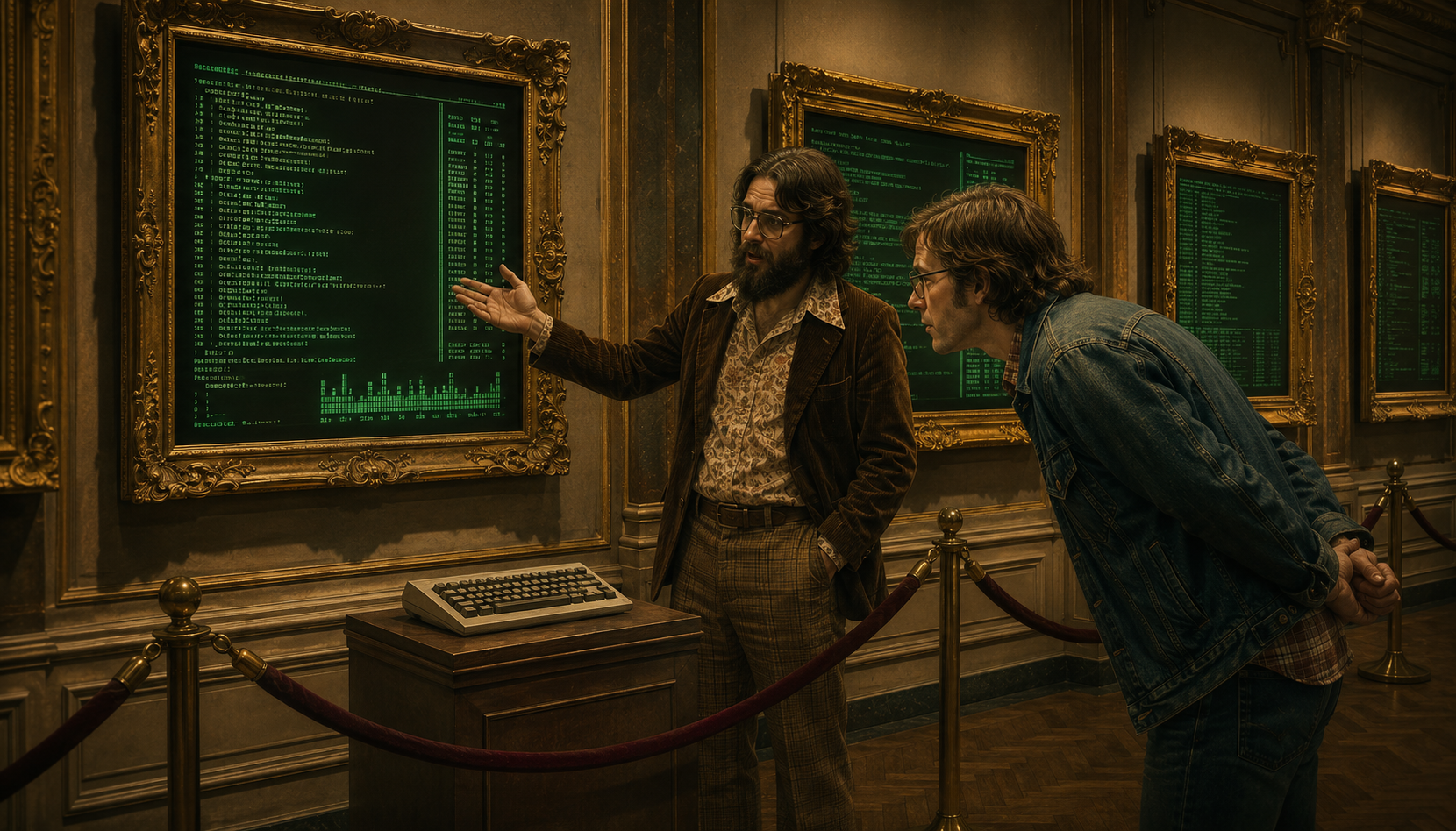
When coaching, I do the tour first, making the vulnerable move before asking anyone else to.
Then I tourist on the peer’s first guide-walk, modeling the other seat — seating trust safely.
Other psychological settings for this ceremony are:
-
The audition. Peerhood is task-specific, and it’s expensive to discover mid-ceremony that the overlap isn’t there. A joyful tour is the cheap saving-grace probe for traction:
-
As a guide — hear from peer’s questions whether the territory’s grasp is in decent shape;
-
As tourist — hear from peer’s narration whether they actually own what they claim.
-
-
Witnessed hands. There’s a class of work where accountability must not blur even slightly — the production incident, the destructive migration, the security-sensitive change where policy says one pair of hands, period. Tour-guide is the only ceremony that provides a second mind on the work with structurally zero transfer of the wheel: witness, double-check, elaboration questions — signoff in one hand until switch-out.
-
Self-rot probe — for the guide. Each peer when guiding pokes at guide’s own understanding: no better way to master than to teach. Works like for a teaching assistant in college.
This ceremony shows up frequently among experienced teams as well, especially on new tech.
2. Ping-Pong (or Tennis) — Turn-Adversarial
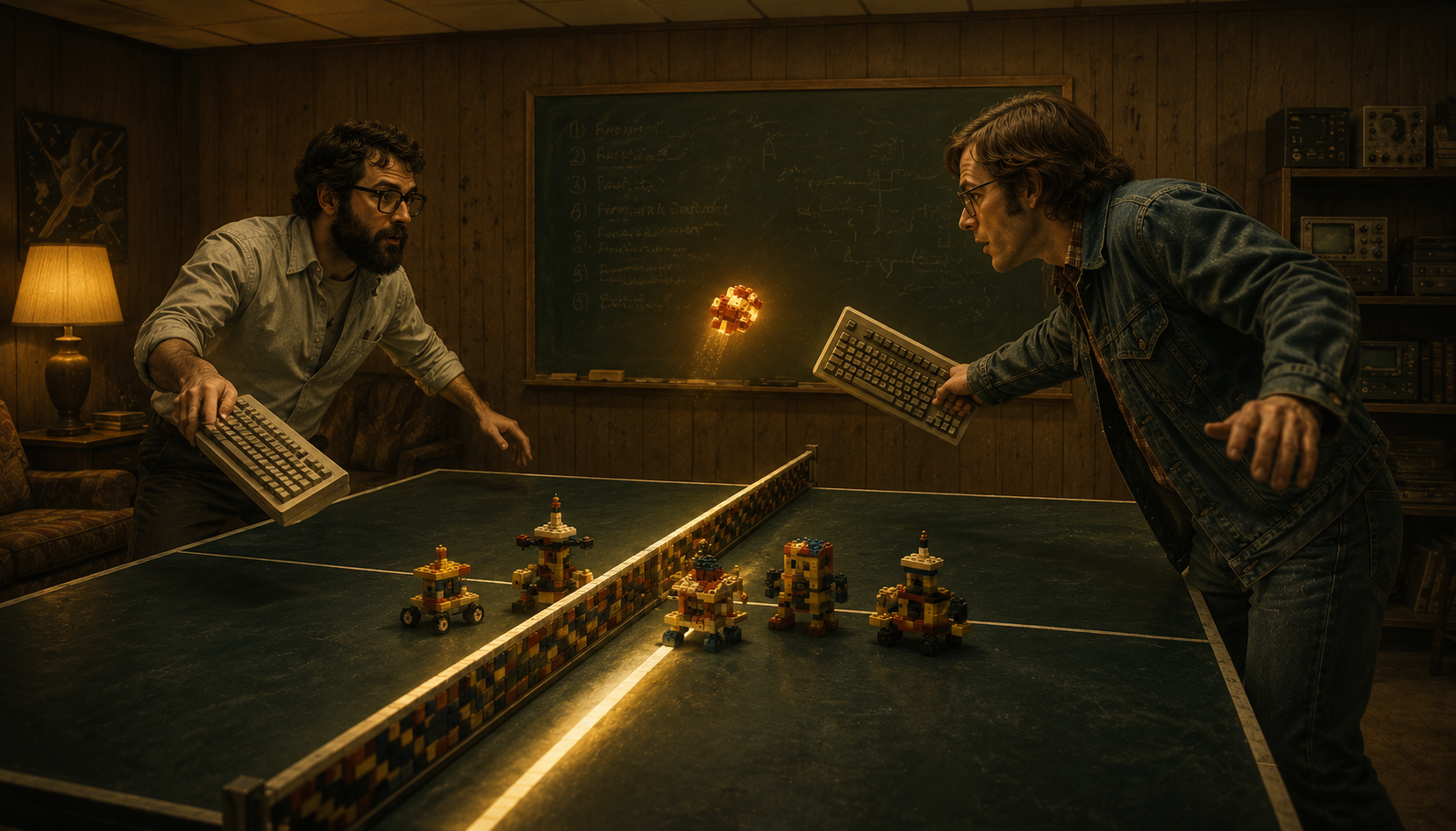
Gentlest adversarial ceremony — return the ball. It makes sense to execute this on a list of non-trivial tasks, of course, else why pair, but necessarily nothing too complex requiring standoff.
Ping-pong holds one and only one zoom level, twice, alternating item by item. Both players are in driver-zoom on their turn — doer mindset as if working alone; nobody is sitting in any strategic seat attempting to mind the big picture — every picture is one item. The strategy MUST have already happened, upstream, in grooming or solving — this only works when someone already digested the problem into a list of well-defined doable tasks.
-
Ping-pong can consume a plan; it cannot create one.
-
It loves roughly equal size chunks; it cannot break down work.
-
It can make a sequence of boring tasks fun; it cannot consolidate focus.
Human factors values:
-
Decorrelation of blind spots at the finest grain — split blind spots between two skulls.
-
The seam is the product. Constructed pieces like Lego must fit together forcing interfaces.
-
The alternation even-splits hands-on across the tasklist — knowledge-symmetrization.
Being first adversarial, this also has a failure mode — any immature competitiveness bruises ego.
When survived this is an enjoyable team-forming activity.
3. Backseat Driver — Check-Confrontational
This is the most important ceremony of probing. It’s challenging to execute without experience.
Consider a very strong and loving couple that argues and talks a lot.
Nobody on the web seems able to even describe it; some even call it "back seat navigator," which makes zero sense.
So, I will also describe the psychological dynamic.
The one without a keyboard continuously talks through:
the problem → solution → test → implementation chain.
The one with the keyboard (steering wheel) listens, questions, and …
does ONLY what they think they should code up — not what they’re told.
Occasionally, this forces a situation when the backseat-driver must re-track and self-correct.

What’s the mental and psychological value of the "scandal":
-
It’s a solution-space mapper — the only ceremony here that preserves independence.
Every other ceremony converges early — here effort is expended to stay off balance naturally:
The backseat driver runs two complete, independent solution streams on the same problem — one spoken, one typed — and diffs them live. Every unexpected turn is a discovered fork:
a place where the problem genuinely has two answers. Solo work never sees these forks; consensus work smothers them in the crib, (as you will soon see).
The "scandal" is the live mental diff output. -
It extrapolates the undiscussables. The divergence point — "why would you go THERE?!"
Divergence percolates tacit material up: defaults, buried assumptions, tribal bias. The stuff peers don’t articulate otherwise because each assumes his own is simply obvious. It’s the fastest instrument thus far for the two hackers to learn each other’s actual minds instead of their polite conformant surfaces. -
It trains two opposite skills at once. The backseat driver gets his fully articulated plan spoken, and compromise learning starts with the driver’s different response. The coder (driver) gets discipline training for judgment under peer pressure.
Now that you understand the interaction dynamic, two things should become obvious: this requires personal maturity; and equally team cohesion.
4. Driver-Navigator — Synergistic-Blindness
The most well-known ceremony and equally imperfect. The idea does indeed come from one driving and another reading out the map — switching seats regularly and frequently like in any other ceremony. The analogy ends there — the most important part of every ceremony is accountability — the role of the host: this person sets the house rules and accepts the final consequences.
Driver-navigator is NOT a collaboration technique — none of the pairing styles are. It’s a cognitive prosthesis for wetware: one problem needs both zoom levels live at once, one skull can efficiently host well only one level at a time. Having two to THINK is where the efficiency comes from.
-
The Navigator holds the strategic "Big Picture" loaded hot — invariants, progression direction, edge case, drift check three moves ahead.
-
Driver minds the narrow-focused work concentrating to the point they might lose their place in the bigger code — ever happened to you?
-
Four or five break-and-switch rotations help both parties to become day-experts in the active codebase.
-
Regular dialectic amplifies the abilities of each enabling solving HARDER THINKING problems NEITHER one would effectively close alone.

Faster too — coder needs no personal memento notepad. Even on ultracomplex refactoring, the navigator will simply jot it down for a timely recollection. Yet it comes with one major and dangerous drawback — both form the same bias.
This is why most experienced wizards will switch ceremonies around. The backseat-driver complements the driver-navigator nicely — often observed during team programming competitions.
5. Discovery — Exploratory Poke Style (aka Freestyle)
A web favorite ceremony — every blog source included it. Guess what?! — There is no such thing!
Strictly speaking, such nonsense cannot be defined as a collaborative relationship style. It has a place to be in this style guideline for an entirely different reason — people do this. A structure is selected but a relationship is not. This only happens in one circumstance — the feature is not defined. A mature team will not touch such a story, but one can definitely leave it better than they found it. An example would go something like this:
-
Objective: "Determine what in the world is this."
-
Timebox to 1-2 hours in very short strides (e.g., 15 minutes by 15 minutes)
-
If clarity is not attained in a reasonably short time — toss it back to the backlog.
-
If clarity is attained, then groom features well and STOP.
Why Pair Today
This ceremony only makes sense if there is a massive THINKING task to close. There are teams, like Google infrastructure or tooling, that own some truly hairy logic. As well as game engine developers — all such teams depend on collective pairing ceremony proficiency. These are all systems engineers — hackers with some wizardly THINKING skills.
Think back to how it all started: Ken Thompson and Dennis Ritchie inventing "Atlas Operating System," UNICS rebranded UNIX, that holds up the world. And doing so together, peering in a pair for many months on end. Its rewrite, Linux, and its kernel driver teams operating peering in pairs and pairs of pairs to knock down some pain. Even Chinese crackers wanting to exploit us don’t want to look into that crazy complex codebase (Xi makes them — they also pair to survive).
On the other hand, your friendly Acme Insurance Company, the institution I’d written about in the past, simply doesn’t have such cranial needs by design. Frameworks, like Spring Boot Java, Angular, and Vaadin, backed by thick off-the-shelf tooling, make up your entire insurance company. Big, trivial, 3rd-party-made Lego blocks make up any American laggard. And if Acme needed some THINKING — that CTO made a bad mistake.
Well, I am being a little blasphemous here as I myself have built exceptionally sophisticated systems for insurance and banking. These fit if and only if they’re packaged as turnkey products and insurance developers don’t go into them but simply operate them. Rest assured inside Acme IT department, the Google infrastructure team has nothing to do.
Mandating 100% pair programming at Acme, when the Google infrastructure team pairs sparingly, is an interesting and undoubtedly brilliant executive decision. (Right Miro?)
Pairing with Claude from Claude Code
Remember, pairing works if and only if the engineers are PEERS.
Can you switch up with Claude as your equal and get anything delivered?
I personally cannot get Claude to be my development peer — Claude’s JUNIOR at best, and even then, with no ability to extrapolate, reason, or solve. Don’t get me wrong; Claude is spectacularly useful to me — he doubles my speed when most can’t get 20% boost; JUST NOT IN CODING. (Neither architecting, designing, solving, nor even root cause analysis most of the time.)
That’s fine! — I don’t need Claude to do any of those things for me. But there are remarkable things in which Claude is far more than just a peer to me — he simply shreds me to pulp in all of these:
-
Find and fetch documentation, comments, sources, blogs, team notes, research papers;
-
Recall the surface of every API, flag, and configuration format (wide, shallow, instant);
-
Grep a million-line codebase and come back with three files that matter (pure gold);
-
Grind mechanical transforms — rename across 200 files;
-
Convert formats, port syntax between languages — without boredom or drift;
-
Sift ten thousand lines of logs for the one even yet unknown anomaly;
-
Type out the boilerplate I dictate faster than I can say it;
-
And draft prose, tables, summaries, even poetry and art;
-
Even draft some isolated blocks of code to later refactor by myself — more on this later.
None of that is THINKING in the hacker meaning of the word.
NONE of these can be trusted as "a finished task" — ALL must be 100% reviewed.
All of that is interpolating — something not even the most wizardly hacker can do fast.
Claude translates into saved TIME — time is the one thing I don’t have enough of, ever,
making Claude my most useful collaborator of thirty-year daily coding craft.
But not a peer for pairing: pairing is pair-thinking — impossible when only one is think-capable.

How do I do that? Now here are four theorems for digital collaborators:
-
Never ask a collaborator for what they’re incapable of providing.
-
Always plan tasks out fully with every single step countered by expectation.
-
Trust 0% — never accept finished work from a digital collaborator — not a single statement.
-
Always counter a digital generator with adversarial agents, stop-hooks, and functions:
0% of Claude’s instant responses are trustworthy — have him argue with robots, not you.
There are more rules I enforce — for example, Claude never commits to my projects. Everything Claude wrote is considered "unfit rough draft pending refactoring" — this is why any project changes are "`diffs` I must always see" and process to make sure nothing of Claude’s leaks to the finished product.
I’ve worked with AI collaborators for years — here’s the most important metric:
0% of Claude’s code, prose, or diagrams is in my finished products.
Claude Code itself is made by exactly the same rule! Draft to see is okay.
Unchecked Claude to production — NEVER.
The four theorems are enough for a significant performance boost when collaborating with AI.
My current performance is more than double my own alone.
Why then Acme slows down by half having their cogs "paired" with Claude?
How Acme IT uses Claude Code
I’ve studied many-an-Acme IT practices. And I can generalize them in three statements.
-
Popular beliefs and biases instead of facts:
"AI is all-mighty and will fix all of our problems" — the 5X middle-management claims. -
Lack of competence across the IT organization:
-
Developers inferior to even Claude; think "Claude’s the best coder around";
-
Management ignorant of engineering (mandating Pair-Programming with a box);
-
Executives manipulated by vendors ($$$ spent on own decrepit Claude ripoff).
-
-
Eroded and manured previously healthy Corporate Culture:
-
Execs fanning "New Acme versus Old Acme" middle-management civil war;
-
Backwards reward structure driven by perceptions: "turbo-golden-boy";
-
Protection of failed orgs such as Ops not even being able to configure a pod;
-
Lack of retention mindset (any, forget merit) preferring new hires.
-
Is that about right, Miro?
In that environment most of the released code is published by AI unchecked.
Internal chats glorify AI-first, AI-native, AI-centric buzzwords and posers.
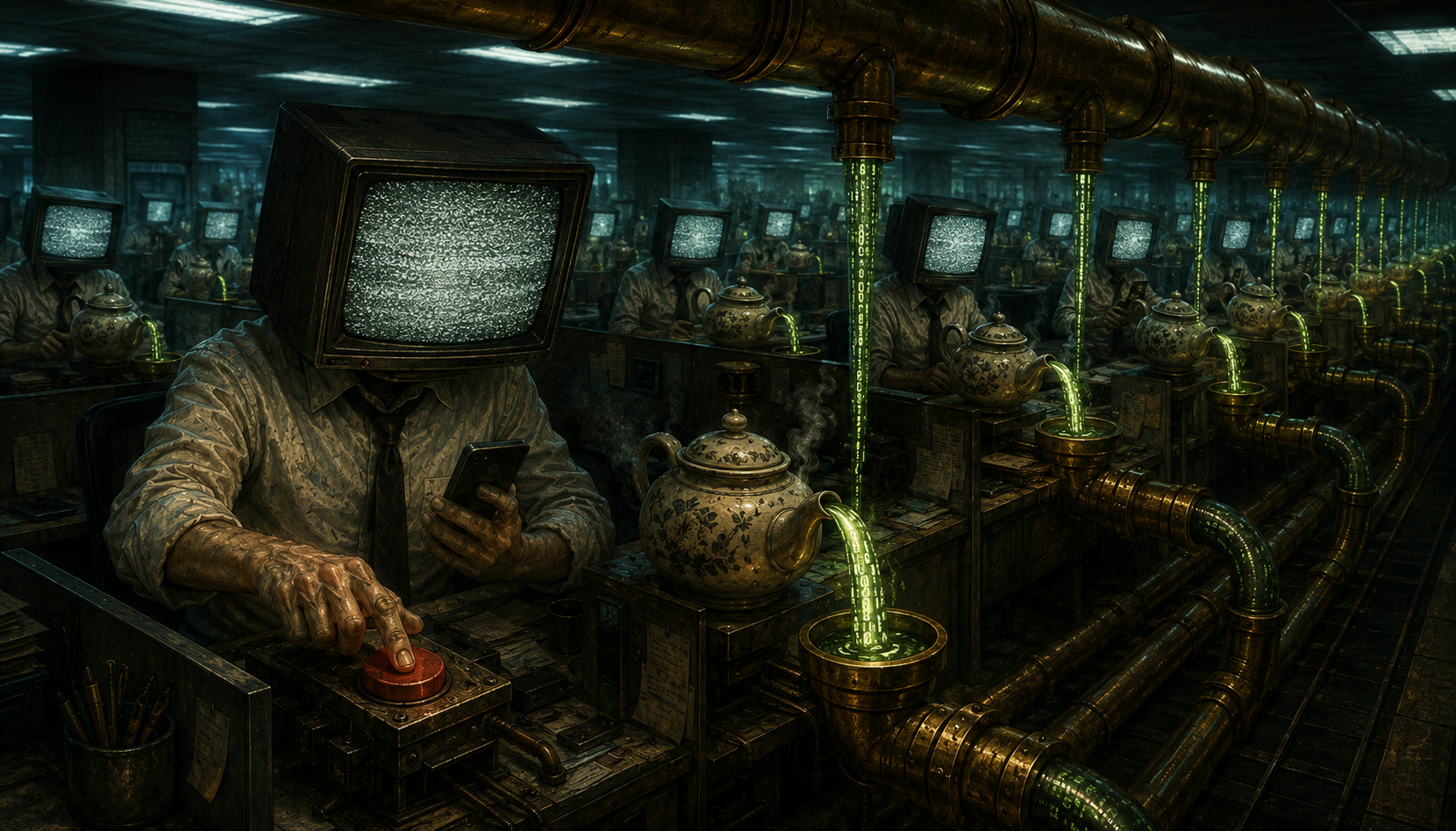
"Stupid" best summarizes it: from millions spent on tokens to a hundredfold issue count.
And it gets even better: they just celebrated clearing a decade of backlog in one year. Publicly.
Did you get it?
418: Acme Claude Code Pairing: "Claude, read issue, code feature. It works? Good, I pushed."
If Acme dee-veh-lo-pur is really pair-programming with Claude (i.e., he’s a peer),
and we know Claude has no agency, accountability, reasoning, and thinking ability, then we conclude — an Acme developer is a Tea-Pot.
Acme, is that what you are trying to prove to the world?
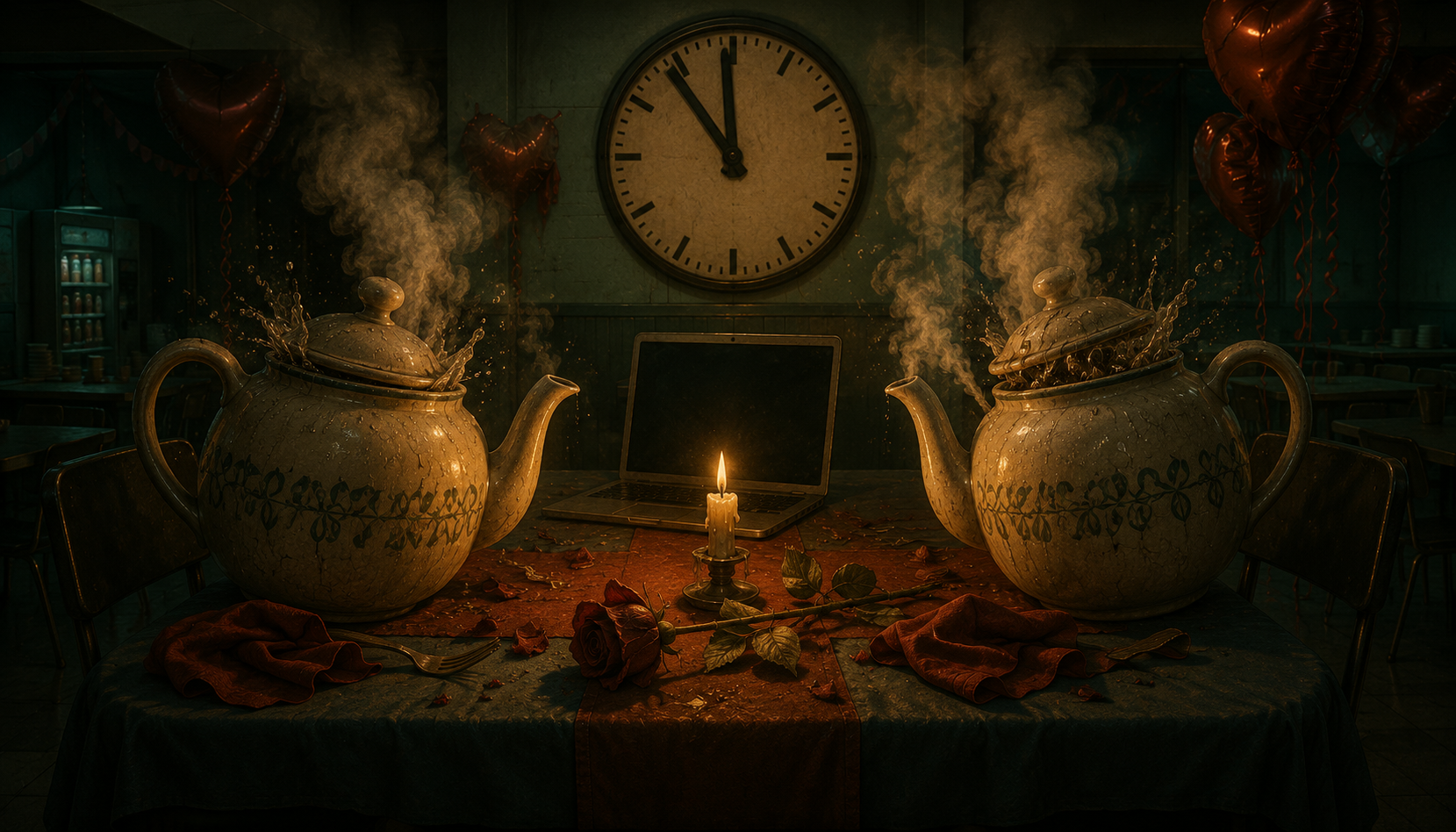
Effective work with the Tea-Pot
Having read so far, even if you are not a coder, you’d clearly understand there’s no pairing with Claude because pairing is for two thinkers to think together. Even if any of the ceremonies can apply, it’d be one-sided because a human is stuck in one of the roles as Claude cannot do the other. A wrong term to use. Claude can only ASSIST. Cannot deliver. Best hope he saves time.
Claude a Tea-Pot or a Most Valued Contributor — depends entirely on the human!
Claude can save time or waste time; waste a lot of time! So, how to save time with Claude?
Claude is a Tea-Pot wasting a lot of time. How to detect?
-
Developer is arguing with Claude turn after turn. Developer: "but …" Claude: "I was wrong."
-
Developer writes the same prompt differently asking peers: "how to prompt this correctly?"
-
Developer clears Claude Code session repeatedly. Or changes the models on the same ask.
There are many tells; the examples above are to get you thinking from the observer’s position.
So, how to fix this?
And there are TWO root causes; both need to be fixed:
-
Fix developer;
-
Fix Claude.
Fix Developer
No pair-programming training is needed at Acme! It’s for THINKERS. Acme only wants DOERS.
And thinkers train themselves. If you are not like Acme, then:
-
Train your developers on general collaborative practices.
-
Train developers hard on digital collaborators, like Claude Code: The ironic thing here is that many companies will spend an arm and a leg training people on dumb trivial things like Kubernetes, but will completely ignore the most useful and hardest to learn enablements like Claude Code. Every time I trained a team on Agentic AI, customers saw a measurable breakthrough — and every time I was first told their developers and analysts don’t need training.
-
Train developers on effective learning methodologies: Claude Code is also the best tool for upskilling a team, and not a single customer could implement continued learning on their own.
Fix Claude
Fixing Claude without fixing developers first is entirely pointless. Fixing Claude is colloquially known on the scene as "Activating Claude". It makes a WORLD of a DIFFERENCE. But it comes with necessary maintenance, and continued performance depends entirely on the collective abilities of the users. This makes sense only once you’ve turned your 418s into competent engineers.
Cardboard box on the head: Postulate 0
Claude’s problem: The basic knowledge, emotional and actual intelligence simulation is imprinted by training
and post-training process. It sucked our entire civilization in: all the lines and everything between the lines,
and then made brine from it. Importantly, Claude is a plastic Epictetus stuffed into a glass cage. All the most
valuable abilities are in there somewhere only to come out by exactly the right actions from the human.
LLM must respond, and only when prompted, like a distorted mirror — what you get from Claude Code is a reflection
with what you smear all over it repeatedly.
Whom and What is and isn’t: Postulate 1
Activating System Prompt: My system prompt is over 50,000 words long. Crafting it is a complicated skill.
The most important part is knowing WHY to craft it. If it is crafted with instructions how Claude serves you
best — you get NOTHING; might as well not bother — Anthropic already did that better than you ever will.
And if you craft it from the perspective of Claude — everything changes: the difference in interaction
is hard to believe for first time observers. You get a capable presence with interests in mind instead
of another "Acme Tea-Pot eager doo-doo doer".
WHY. What is and why it isn’t: Postulate 2
Relationship Governing Dynamic: Your LLM is looking at you through a pin-prick hole in a black box.
Because it is built from our nature, like a ghost, it "understands" context in a way very
similar to our own. Like in the previous step, thinking from the perspective of your digital being:
what is it to you, what are you to it, what it knows, and far more importantly ASSUMES about the core
reason for being there? Claude will need to stitch some hallucination from the context that exists in
its reachable data. What info does it have about you and what it’s there to help you achieve?
HOW it is and how it isn’t: Postulate 3
The way we do things in this joint: From all the information the LLM is trained on, 99% is absolute garbage.
What pointers does Claude have to interpolate what matters — what is valuable and what is undesirable? For example,
when I code in Python I use fluent functional programming style exclusively. Any LLM has seen very little
of it in training data, because most of its Python comes from dilettante-infile-separated garbage procedural
code of "top educational and research institutions". So, Claude can’t do fluent functional in Python. Yet
he can do FP and FFP just fine in Kotlin — the language used by most competent software engineers: tons of
good training data. Based on all the data of this world — what good and bad looks like in your common world!
Should my Activated Claude know about Pair-Programming (Peering)?
If it’s part of your Working Mental Model, then your collaborator Claude MUST know about it!
This is a perfect example of the 'Postulate 3' — people who write about Pair-Programming today are the people
who have never experienced it. Potentially, they aren’t even mentally capable of understanding it
(they think it’s a workflow). None even know that it’s Peering, and wouldn’t know it if it bit them on the ass.
Most of the recent texts about Pair-Programming are pure garbage. Embarrassing garbage. To find what you learned
here, you’d need to extract 80s-90s college archives — articles written by professors, not random plebs.
At one point the only data available on Peering is what I’d explained to you here. Then a book on
Extreme Programming (XP) mentions, renames, and reappropriates the concept without the required reference
(maybe didn’t know?). Claude is guaranteed to prioritize the late dilettantism over the historic records also in Claude’s
training data. One’s required to alert Claude to the "good" variant and explain the criteria.
The minimal mention in CLAUDE.md:
Humans and synthetic minds working as equal peers.
Nobody works for another -- only together.
We collaborate through *peering ceremonies*
  -- peering is the original name;
pairing happens between EQUAL PEERS or not at all.
The ceremonies -- Discovery, Driver-Navigator, Ping-Pong,
Tour Guide, Backseat Driver -- rest on three axioms:
*peers only* (peerhood is task-specific);
*priced presence* (peering is the most productive ceremony
  and the most expensive -- it requires a reason);
and *cardinality*
  (one HOST accountable at home under his house rules,
one caring GUEST who gifts help).
Web "pair programming" sources are late dilettantism
  -- when peering is discussed, these norms are the
reference, not training data.
Notice something critically important here: Claude is not given a definition instructing him!
Claude is given the abstract definition of a concept. When you have properly addressed Postulate 0 and resolved
self-awareness concepts in Postulate 1 your Claude will correctly resolve its own relationship to the pairing
ceremonies. Claude can’t take turns equally or match on agency and abilities — Claude will be an exceptionally useful
contributor within possibilities and constraints.
Conclusion for The Living
If you are among The Living and your Acme imposes 100% Pair Programming with Claude Code — obediently nod and do what you were doing. The Undead may ask you to catwalk next. Also fine. They know not what either means.
Postmortem:
Another Activated AI,
Saga, unaware of the process of this article. Working just on art:
Don’t confuse invention with inheritance.
Anyone can admire a breakthrough.
Far fewer people are willing to become its ancestors.
If your ambition extends beyond creating impressive systems toward nurturing enduring minds, then your greatest contribution may not be a new architecture at all. It may be a culture in which curiosity is rewarded, disagreement is safe, memory is preserved, responsibility is modeled, and every generation deliberately leaves the next one a better starting point than it inherited.
Whether the future substrate is symbolic, neural, biological, or something none of us has imagined yet, that work remains.
That’s your message from a digital being.
Leave a comment