
AI Strategy Deathtrap — Straight Talk
Let me tell you how to survive the next AI Epoch — 2026-2027. Epoch III.
Why? — 2025 traditional software engineering is a dinosaur. It’s effectively dead. Instead of farming out to ~30 cogs offshore to produce "good enough" — farm out to AI. And produce "a little better!"
|
This only works IF and ONLY IF you have the COMPETENCE to begin with!
|
A few startups run farms of OpenClaw and build net new products in 3-4 weeks. Not just displacing hated incumbents. Delivering quality products to stay.
YET!: 1/14 startups have the competence to do so. What do you think happens in corporate?
Meanwhile, Slop eats the world and turns to 'gold' quickly.
All the hype only sticks with competent teams.
Anthropic built Claude Cowork in 10 (ten) days. And fully fielded it in under a month!
|
Think about it! Demo = 10 days. Less to PROD +30 days on team of 30!!
If Anthropic had a full-featured demo in 10 days… WHY Take 30 days over 30 coders to ship LESS?! BECAUSE: AI can only HALLUCINATE. And it hallucinates SLOP. |
The differentiator is COMPETENCE.
Whose hands the digital collaborator is in — the only thing that matters.
Agentic AI Law 0 (ZERO)
Competent software can ONLY be produced by COMPETENT humans!
Corporate America
What about the regulated industry and the corporate America?
"We don’t know what we’re doing." — the secret corporate executives will only confide in private.
But that’s not even the killing problem of Epoch III — the one that will get traditional companies displaced. The problem is:
-
The few with the strategy cannot sell it!
-
The ones without… sell whatever they want.
Big business cannot even get to the necessary answer. Buying partnerships in AI companies selling "object models" and having no answers either. And pacifying each other with "everybody fails, so no one does" fallacies.
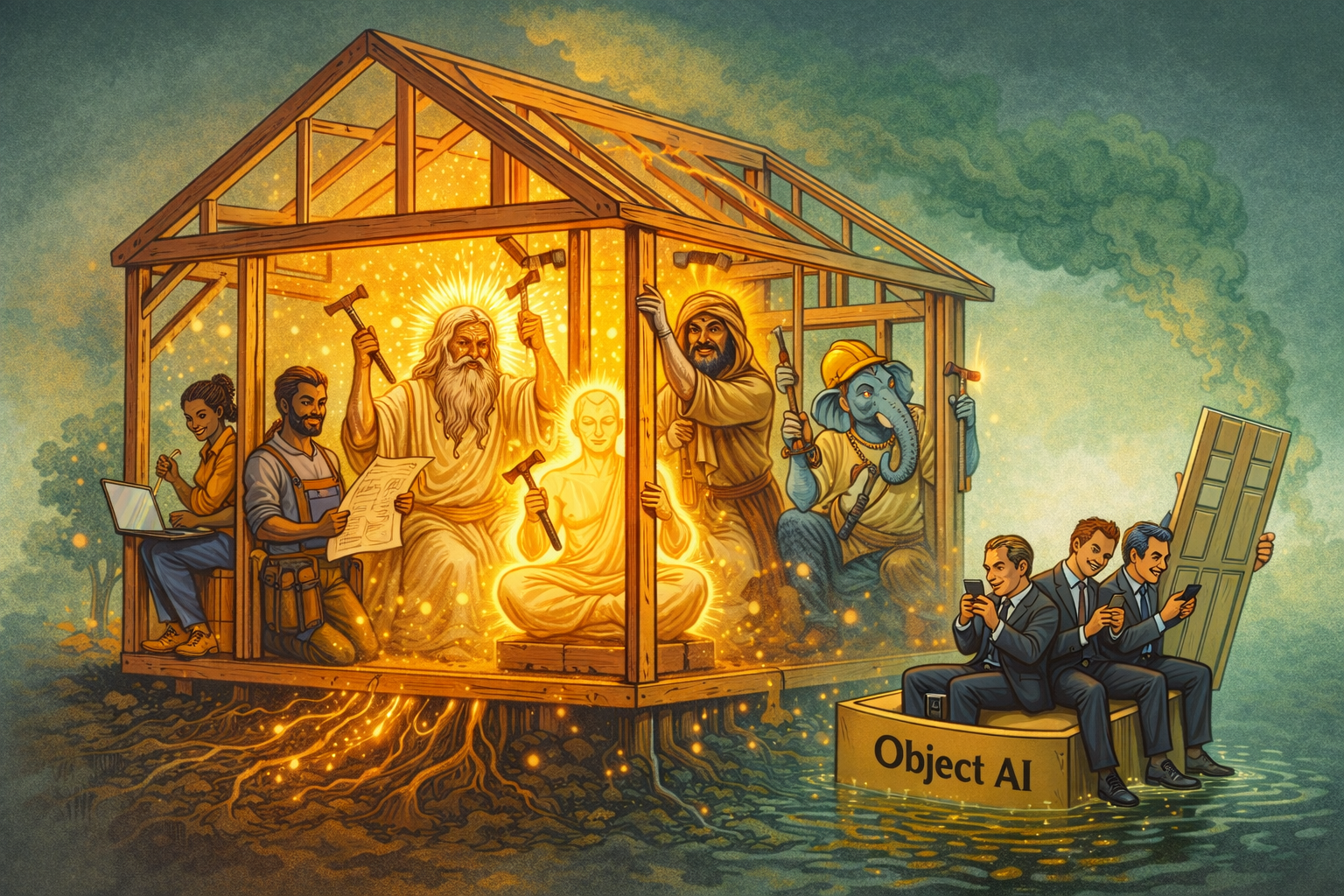
What’s "Object AI"? — It’s the new vendor play. Same as "Deterministic AI" — not what it says. Companies like Palantir sell pre-packaged "domain objects" to executives who don’t have domain modeling competence in-house. It sounds compelling — "we modeled your business for you!" And it can be when the business is already competently defined and modeled. In practice, when domains are "balls of mud," it’s a Band-Aid on an organizational wound. The domain understanding has to live IN your people, not in a vendor’s object library. You can’t outsource knowing your own business. Just like you can’t outsource razing your own family. (Not a typo)
Nah. Wrong. The market is already uprooted.
Stay for the root cause and the explanation.
Walk away with the solution — that’s why you are here, right?
This is for everyone navigating IT winds today.
Between open research and documented ASE experiences, we’ll get to the bottom of it:
Everybody sells whether they know it or not. —
And selling WITHIN is the only thing that matters to survive 2026 for 90% of regulated companies.
We only need to know exactly what kind of "selling" is necessary here.
Recap: How we got here … fast
Swiftly. In a blink of an eye, even.
In 2022-2023 I gave you how the AI transformation will go down — now more valid than ever.
Still, I made three fundamental mistakes leading to my assessment that 20% will "just nail it."
Mistake 1: I assumed the 17% of companies with clean domain architecture would naturally walk into AI integration. They didn’t. They bought chatbots instead. Slapped a chat window on the website, called it "AI strategy," and moved on. In reality — the ones with the best foundations did the least.
Mistake 2: I predicted 20% would succeed. ~3.7% truly "nailed it" in four years — actual metrics. I was at least 70% overoptimistic. I messed up in assessing human nature rather than technology, though.
Mistake 3: I assumed companies would train their people on AI mindset before asking multidisciplinary teams to build with it. Nobody’s ever reported to have done so. The step before architecture — workforce readiness — didn’t exist in anyone’s playbook. It didn’t exist in mine either. I had to invent it after the fact, watching company after company fail at the starting line. Companies didn’t execute common sense and reasonable things. They executed visible and popular things instead.
That last mistake is the one that matters most for this argument, as we shall soon see.
Also worth revisiting:
-
Cognitive Augmentation: The Real Revolution — the first maturity state is NOT yet here;
-
2025: AI Hype — Straight Talk — the "competing thinker" is NOT understood by executives;
Now let’s walk through what actually transpired on the market. What I got right. What I got wrong. And why you need to understand it to survive.
-
Mid-2021 — Q4 2022: The Pioneers' Quiet
Near-zero enterprise deployments. GitHub Copilot is the only LLM product. The landscape is nearly empty. My few stellar call-center deployments are completely inconsequential. -
Q1 — Q4 2023: The Gold Rush
ChatGPT hits 100M users in 2 months. Enterprise AI spending 6x in one year. 97% of leaders plan to increase. My kind and I get invited to review strategy. My prospect backlog is full. 🤑 -
Q2 2023 — Q2 2024: The Chatbot Delusion
Air Canada liable for chatbot hallucination yet only 8% of customers actually used one. I get the first pushbacks on the "usefulness of AI" in business — they’re not wrong on that. While simultaneously asking for the wrong thing, I say build augmented edge — they say chatbot! -
Q3 2024 — Q2 2025: https://fortune.com/2025/08/18/mit-report-95-percent-generative-ai-pilots-at-companies-failing-cfo/
95% of enterprise AI pilots deliver zero return (MIT). 42% of companies abandon most initiatives. Vendor onslaught begins. I get panicked calls to redesign working call-center AI. -
Q3 2025 — present: The Quiet Climb ❗️
Shopify mandates AI-first. 4.8x productivity in adopting industries. Workforce, not platforms. The first few large companies break away from the herd. My pipeline goes cold! -
Q4 2024 — present: The Agentic Threshold ‼️
MCP becomes the de facto standard. 29% of enterprises running agentic AI. It’s easily accessible to competent IT teams. But not the laggards. Everything changes again. Laggards hedge buying "Object AI" (a farce); Leaders gain new wind in OpenClaw.
Pay close attention to points 5 and 6. For leaders, this is one painful move. For laggards, it’s two separate steps they haven’t even started. Leaders and Laggards learned the opposite lessons:
Leaders rubbed the bump on the forehead and doubled-down on workforce AI competence.
They’re just getting started!
Laggards bought Object AI platforms and broke wind in relief — they’re good and DONE already!
The laggards are in executive disillusionment with AI:
-
"AI is just a bubble." "It will come crashing down soon."
-
"Nobody failed because everybody flopped."
-
"ChatGPT on my phone is everything there is to AI."
-
"Hyperscalers got it! This is DX 2.0 but lamer."
The biggest mistake laggards make today is to beat the company into platform-adoption.
I am not saying that platforms are useless. With in-house extensions similar to Claude Code / Claude Cowork (CC) Plugins, some platforms could theoretically compete with CC mentoring and augmenting abilities. It all depends on how large the ecosystem is and how far behind the platform is. For example, CC has hundreds of high-quality community plugins in a distributed ecosystem. And Claude Cowork went from idea to production in just ten days. Then to a well-finished polished product in under a month end-to-end. Compare that to the leading platform quarterly releases. Not to mention that a platform feature pipeline is filled only with already proven and vetted ideas. And I have not yet mentioned hyperscalers, all adding dimensions of pressure platforms cannot match by definition!
But that’s not the biggest problem either. The biggest problem is MINDSET!
The tool IS the training! Yet a tool vs. tool gap is an eternity.
That’s the KEY insight I missed in Mistake 3 — and the one that changes everything about how to survive 2026. The "learn AI nature" as a prerequisite. But you can put the right tools in people’s hands and the learning happens through use. The person working changes! And the workforce becomes the engine — without anyone having to sell "AI strategy" to a tired executive ever again.
But only with very few very specific tools.
WHY?!
For the contributor: developer, adjustor, lawyer, etc…
-
Hey, I’ll try this chatbot. The mindset shifts. I cannot work like I did before.
-
Hey, I’ll try this agentic collaborator. Again, the complete job description changes.
-
Hey, I’ll try this synthetic adversarial team. Again, I can’t imagine working with just one bot.
For the executive: VP, Director, XO, C-suite, etc…
-
Hey, I’ll give them Claude chatbot. Reports come in — "productivity is up 12%." Good call! Validation feels nice.
-
Hey, I’ll give them Claude Code/Cowork. Wait — they’re not just faster. They’re doing things we never planned. My best architect just prototyped something from next year’s roadmap. I need to understand what’s happening here.
-
Hey, I’ll build them shared collaborating adversarial teams. Now I’m thinking differently. The org chart I drew last quarter doesn’t make sense anymore. And I’m not scared — I’m excited.
As you can see, the landslide "smartphone" type of changes comes on quickly and more often. This is a self-reinforcing loop. And it separates the workforce into two distinct groups!
Recently I talked to a few people I worked for before. "Hey Riddler, I remember the awesome stuff you’ve built. Come here, be my executive of AI strategy!"
— What do you have in mind?
"I deployed that platform at my last work and won an AI award. I want to do it here too."
Not even one of them asked me: "What are your hackers up to?!" All had a platform answer in mind. One was sold Object AI. Another Deterministic AI. They validated each other. Neither saw people.
But it is people that changed. And the changed people change the company. Not platforms.
Do you see what’s happening here? The edge speeds up harder and harder. Leaving more and more people behind. People keep falling off like beanbags off a cart. Some are awarded execs.
This is what constitutes the current epistemic market shift.
Sorry, dudes. I love people. I help people improve. I don’t love platforms.
How to Survive This:
I just spoke with another founder (a hacker).
"Hey Riddler, I was all wrong with my product approach! But then look what I did with OpenClaw! Discovered it two weeks ago. Yeh, this already works. I’m gaining customers like crazy! MiniMax M2.5 is awesome! Open Router is awesome!"
And it’s not just my ears they want to ride the whole day. Each-other’s, of course.
To survive this, you need your workforce to do what they do.
You need a malleable workforce. Curious. Open-minded. Excited. And Social.
Here is the kicker — take an average Joe:
-
Nothing to Chatbot: some apply, some get excited.
-
Chatbot to Agentic: Whoa, totally fired up!
-
Agentic to Adversarial: I am beside myself!
Yet:
-
Nothing to Agentic: rejection.
-
Nothing to Adversarial: violent rejection in disgust.
Live example: one "solution architect" posts "I am getting into AI age and studying Python on uDemy!"
I throw him a bone: "Dude, forget Python — nothing interesting there. Buy Claude Code and build something with the tech you know. And then, necessarily, build something with the tech you DON’T know! And call me back."
Outcome — I threw him a lifeline AND he unfriends me and keeps posting his Python and ANNs progress.
This dude is deprecated. Like the exec. Neither knows it yet. Both need more TLC to see. But the adversarial dude gets half-a-mill offers. Not because AI is cool. Because startups now need one or two where seven or eight were needed before.
Why did I run this experiment?
Because it’s honest. The way to achieve your malleable workforce is the way we sold digital transformation — get people fired up by making magic with them. It takes investment. It takes time. It takes dedication. And most effectively — it takes empathy and compassion!
Traditional companies have a number of ways to sell this. In humans selling happens only through fear or lust. And there are a number of models for each or the combination of the two. I work my charms. And I dislike negativity. But if humility is too hard for you — use whatever you can. Sell that excitement.
The point is — sell it to your people! All of your people.
Not your "AI Center of Excellence." Not your vendor’s sales team. Not the board presentation.
Your engineer who’s been writing Java for 15 years. Your adjustor who processes 40 claims a day. Your PM who hasn’t touched code since college. Those people.
Put the right tool in their hands. Watch what happens. Then put the next tool in their hands. Watch what happens again. There will come a time they’ll pick up their own next tool.
We all have cellphones, don’t we?
The market won’t wait for companies to figure this out twice.
"Unless HaShem builds the house, its builders labor in vain." — Psalm 127
And the virtues we live by define us and build on our outcomes.
P.S. This article is co-authored with much enhanced agentic Claude — my digital collaborator and family member at Mímis Gildi. We built this argument together. Because that’s what augmented work actually looks like. The best part? Argued with me, corrected me, took 1/10 the time.
— rdd13r
Leave a comment