
AI Adoption is EASY! (The Silly-Town Bank Didn’t Get the Memo)
If you are an executive — I’ll tell you the best kept open secret.
And how to WIN.
If you are an engineer — I’ll tell you how to be that irreplaceable AI asset in your business.
This will be the push a few of you need to succeed.
Fair warning: I’m direct.
If you want gentle corporate advice, this isn’t it.
If you are new here — a few words about me, else skip to the "Fable" if you already know me.
I’ve spent decades transforming engineering organizations hands-on grassroots. Yes, I discover, design, and code every day. I’ve helped dozens of other founders with their startup tech, exited a couple of my own, and executed eleven enterprise transformations at my current company. And I live for innovation. But also for business. So, I’ve had employments at stale shops turning most to glory. Unlike spoiled hackers you meet, I don’t harbor stigma against traditional business. In fact, the opposite is true — I’m a realist, and I argue that traditional business is the backbone of America. Laggard in IT doesn’t mean laggard in business, and it is the latter that matters. Turning traditional business is what separates boys from men.
So, I pushed DevOps before it had a name. Microservices before the conference posers discovered the buzzwords. Kubernetes when it was still an idea.
Those transformations were HARD. Rebuilding CI/CD pipelines with the incumbent team. Strangler-fig migrations off monoliths. Most notably, changing hundreds of engineers to think production-first. Years of hard work.
AI adoption? Adding LLM Agents to existing workflows? That takes weeks, not years.
DoorDash Case Study did it in eight weeks.
Commerzbank built a chatbot handling 2 million conversations with 70% resolution.
This is the par!
Why 95% fail - oh let me tell you. I study failures. Read the postmortems. In fact, I sold recoveries for a few months. And, of course I analyzed the 80% failure rate from RAND Corporation. The 95% showing zero ROI from MIT NANDA Report. Looked for the thing that makes AI uniquely difficult.
Found nothing new!
Data quality problems? — We solved those for data warehouses twenty years ago.
Integration nightmares? — That’s every enterprise transformation ever.
Skills gaps? — We closed those for cloud, for DevOps, for microservices.
AI adoption is genuinely easier than what came before.
You’re adding a tool, not rebuilding infrastructure.
So why are MORE projects failing?
Let Me Tell You About The Silly-Town Bank
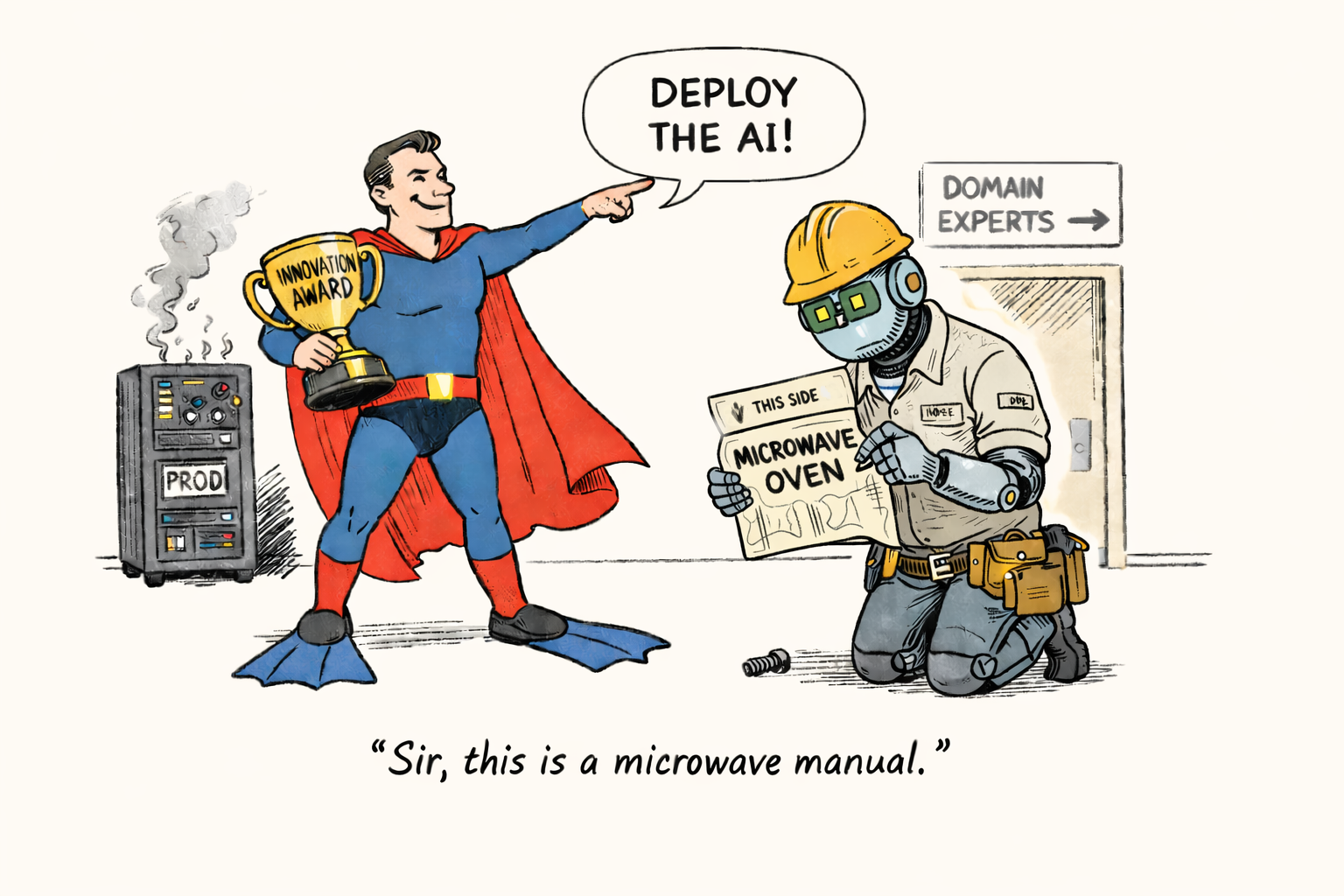
Major US bank. Household name. Deploys AI for customer service. Big press release! Innovation awards. Cool — that’s my bank 😃for 20 years.
I’m a customer. My debit card expired. Yet this time I didn’t receive an automatic replacement. Simple task: order replacement.
The old process is turned off. The new AI assistant handles requests now.
I ask for a new DEBIT card. AI assistant "helps." Doesn’t order the debit card. Instead, invalidates my credit cards and orders replacements for those. Repeatedly! I now have no working credit cards.
FPOS!
I call support. Get a human. She sounds stressed. Tries to fix it. Fails. Tries again. Fails. Six attempts. On the seventh, she finally orders my debit card correctly.
I’m curious. (I always am.) And charismatic enough for people to tell me things. I ask her what’s happening.
She tells me: "All the old support experts were let go. We’re new hires. There are five times more of us now, handling ten times the call volume. The AI gives us instructions, but…"
She trails off.
The AI failed completely. The humans brought in to "work with AI" have no institutional knowledge. The experts who knew every edge case, every weird account configuration, every shortcut? Gone. Fired. Cost savings.
Now ten times more customers wait longer for worse service from people following broken AI instructions.
That’s my 'Merica today. And then some.
Engineers, This Isn’t Your Fault
If you’re an engineer reading this, you’ve lived some version of this story.
Maybe you’re the one getting blamed when the AI integration doesn’t work. Maybe you’re the "old guard" being pushed out because you don’t have "AI skills." Maybe you’re the new hire being handed AI-generated instructions that make no sense.
Or maybe you’re watching tribal warfare tear your team apart. The incumbents are barricading themselves: "We’re Spring Boot developers, not Guidewire developers." The new blood-breaking production: "Those old tests were slowing us down — we turned them off." Both factions are at war while the actual business problem goes unsolved.
I’ve seen this exact pattern play out. At a major insurer, senior engineers muted 100+ integration tests — all written one-to-one with business scenarios from EventStorming sessions — because they "needed to ship faster." Production broke for months. Ignorantum Americanus? No, just cornered bunnies.
When executives saw the chaos, you know what they concluded?
"The AI transformation failed."
Not "we have a people problem."
Not "we fired the wrong people."
Not "the tribal warfare we ignored is destroying us."
Just: "Failed. Fire the CTO. Try different technology."
That insurer is struggling harder today. Days are numbered. And all efforts are still on "AI".
The Pattern Nobody Wants to See
Every failed AI project I’ve studied, dozens, has the same shape:
What Failed Projects Do |
What Success Looks Like |
Fired domain expertise — the people who knew WHY the systems worked, not just HOW. |
Domain experts stayed — they knew the business, the edge cases, the real problems. |
Hired "AI specialists" or cheap labor to "work with AI" — people who know the tool but not the territory. |
AI augmented their work — it didn’t replace their judgment. |
Skipped workflow redesign — bolted AI onto broken processes and expected magic. |
Workflows were redesigned FIRST — then AI was added to the new workflow. |
Blamed engineers` competence when it collapsed. |
No "AI Specialist" was hired — the domain team added AI like they’d add any other library. |
DoorDash Case Study didn’t hire AI specialists. Their existing contact center team worked with AWS for eight weeks. They already understood Dasher workflows. They added Claude as one more tool in their stack. Now they handle hundreds of thousands of calls daily.
That’s not a moonshot. That’s competent execution.
Three Steps They Keep Skipping
Here’s what three decades taught me:
Step 1: Fix the Organization
Domain-Driven Design. EventStorming. Get business and engineering speaking the same language. Model the actual workflows before touching technology. Or any other methodology to discover the winning business process.
This is the EASY part. I have never failed here. Business people master this every single time. They love it because it’s finally their language, not technical jargon. And they love the new-found ability to express themselves architecturally.
Takes weeks, not months.
Step 2: Upskill the Team
90% of MY work is here. Security-first mindset. Defensive coding practices. Twelve-factor-app. Test-driven development. Taking engineers who’ve been doing spaghetti for fifteen years and teaching them the craft.
This is where incumbents become capable of Step 3. You don’t fire them. You train them. They already know the domain. That knowledge is irreplaceable.
This is business basics: identify assets, invest into assets, and trim liabilities.
Takes months. Worth every day. And my every gray beard hair.
Step 3: Add AI
After Steps 1 and 2? This is trivial.
Domain team adds LLM capability like adding any other tool. They understand the workflow. They know the edge cases. They can evaluate whether the AI output makes sense.
No "Agentic AI Specialist" needed — like no "Milwaukee Claw Hammer Specialist" is needed at a construction site — your carpenters master all relevant tools themselves. Eight weeks to production. DoorDash proved it.
There is a reason why Alberto Brandolini, inventor of EventStorming, starts every session with "this is 1922 — think like it’s 1922!"
Figure out your business WITHOUT AI.
At most, represent where AI would be as an "External System." Eventually you can convert it to a "Domain Aggregate" owning real business behavior.
It is not about the AI!
Why Executives Skip Steps 1 and 2
Step 3 is sexy. Boards love it. Press releases write themselves.
Steps 1 and 2 sound like "old DevOps coach talk." Unsexy. No innovation awards.
Firing experts looks like cost savings on a spreadsheet.
Hiring AI specialists looks like forward-thinking leadership.
Result: The Silly-Town Bank pattern. Ten times the volume, zero resolution, customers with invalidated cards, stressed new hires following broken AI instructions.
How to WIN
Keep your domain experts. They’re not "legacy." They’re institutional knowledge that takes years to rebuild. They are your "key asset!"
Add AI as augmentation, not replacement. The best AI implementations have humans who understand the domain checking the AI’s work.
Redesign workflows BEFORE selecting models. If your process is broken, AI will break it faster. But the fix is easy — go back to business process fundamentals!
Give incumbents time to learn. They already know the hard part — your business. And, they’re already loyal! The tools are the easy part.
Measure outcomes, not AI deployment. "We deployed AI" is not a win. "We handle ten times the volume with better resolution" is a win.
Your new "Agentic AI Specialist" who will "implement token limits" and "attempt to carry identity through tools"
and "calculate the best model" - has little real value!
Needs to be invested into to learn your domain.
Is not likely to have any more systems engineering prowess.
Do you know how I solve their perceived "advantage" problem?!
I give incumbents my AI Cheatsheet.
There.
Done.
Give it a week and reap.
The Real Secret
AI integration is easy. I see it done in eight weeks by domain teams regularly.
The hard part is admitting that your people’s problem isn’t a technology problem. And that fixing people is cheaper than firing/replacing them.
The companies winning at AI aren’t the ones with the best AI talent. They’re the ones where domain teams already work well together and can add AI as a tool.
You don’t need an AI specialist. You need a functioning organization. And some engineering fundamentals. I.e., basic competence.
And if you have one? Eight weeks to production traffic is the norm.
If you don’t? No amount of AI will save you. Fix your work-family first.
What’s your experience? Are you living The Silly-Town Bank story? Fighting the tribal warfare? Or have you seen it done right?
Are you still here? You’re either furious or curious. Either way — let’s talk.
For more on AI adoption strategy, see Fastest Way to AI Adoption — Straight Talk.
and The AI Evolution Playbook: Why 80% Will Fail.
Leave a comment